
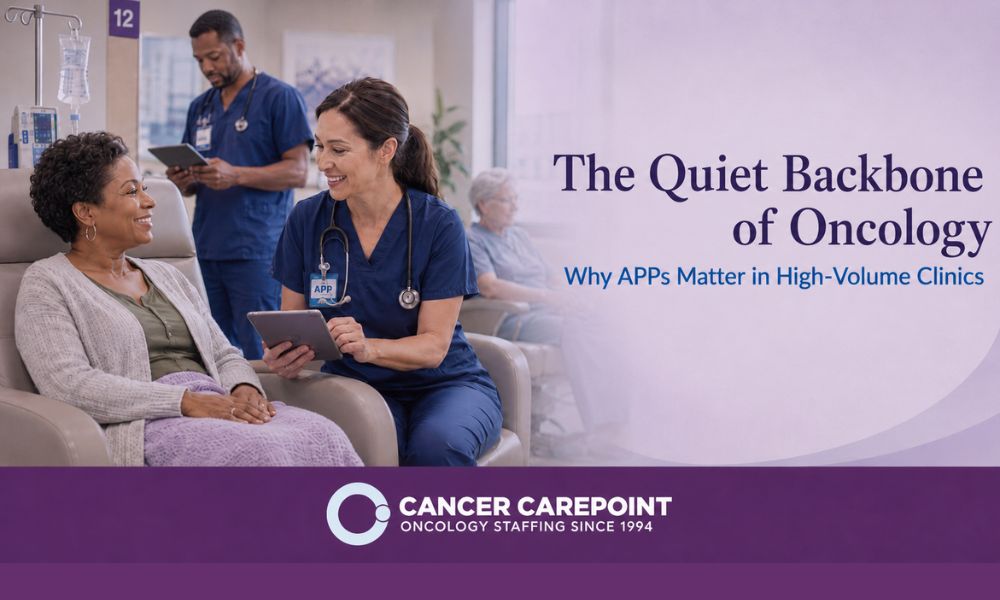
High-volume oncology clinics are running out of room to absorb demand. With more than 2 million new cancer diagnoses in 2025 and oncologist density relative to the aging population dropping from 16 to 15 per 100,000 adults aged 55 and older over the past decade, the math no longer works without advanced practice providers.
APPs are not a supplement to the oncology team. In clinics operating at scale, they are what keeps the schedule moving, the patients seen, and the care continuous.
The Structural Gap APPs Fill
The 2025 ASCO workforce report projects a shortage of more than 2,200 hematologists and medical oncologists in the US this year alone. Sixty-eight percent of Americans aged 55 and older live in counties where oncologist coverage is already at risk.
APPs absorb the volume that would otherwise sit in queues. In community and academic oncology practices alike, nurse practitioners (NPs) and physician assistants (PAs) manage follow-up visits, treatment toxicity assessments, oral chemotherapy adherence checks, and urgent symptom calls that do not require physician-level decision-making but cannot be left unaddressed. Without that coverage layer, patient access erodes, and physician burnout accelerates.
What APPs Actually Do in a High-Volume Oncology Clinic
The scope is broader than most facility leaders initially account for when planning staffing models. A survey-based analysis of APP practice patterns found that oncology APPs are frequently or always involved in patient education (84% of cases), ordering imaging and laboratory studies (69%), and making supportive care decisions (62%).
These are not peripheral functions. They sit directly in the critical path of every active treatment patient.
In infusion centers specifically, APPs serve as the first clinical contact for patients presenting with hypersensitivity reactions, treatment-related symptoms, and post-treatment complications. Research published by the Oncology Nursing Society found that in an APP-led infusion model, 39 of 45 patients presenting with acute issues were treated and discharged home without escalation to inpatient care. That single outcome carries high cost and capacity implications for any program.
The Operational Case for APP Integration
Workflow disruption in high-volume oncology is not abstract. When an infusion chair fills and no clinical provider is available to clear a pre-treatment assessment or manage a symptom concern, the entire schedule backs up. Patients with active malignancies absorb treatment delays poorly, and tumor boards and surgical scheduling feel the downstream effects within days.
More than 60% of oncologists surveyed report that APPs enhance practice efficiency by managing routine visits and reducing interruptions to physician time. In practice, that translates to physicians staying focused on complex case management, new diagnoses, and treatment plan development while APPs maintain the continuity visits that make up the bulk of active treatment volume.
A weekly NP-led symptom management clinic for patients receiving concurrent chemotherapy and radiation has been shown to reduce acute care hospitalization rates and chemotherapy dose deviations. In radiation oncology, where treatment adherence directly correlates with cure rates in many disease sites, that kind of intervention has meaningful clinical weight.
Geographic Reality and Rural Program Survival
The workforce gap is not evenly distributed. ASCO projects that non-metropolitan areas will meet only 29% of their demand for medical and hematology oncologists by 2037.
For cancer programs in smaller markets, APPs are not a preferred staffing model. They are often the difference between a program that remains viable and one that closes access entirely.
Rural and community oncology programs that have built sustainable APP integration, with clearly defined collaborative practice agreements and structured onboarding to site-specific protocols, consistently outperform peers in patient throughput and provider retention. The oncologist who is not drowning in follow-up visits is also the oncologist who stays.
What Gets Missed When APP Roles Are Underutilized
Some oncology programs staff APPs reactively: they add a position after the schedule breaks, or they limit APP scope in ways that do not reflect actual clinical capability. Both patterns carry cost.
An NP or PA restricted to administrative tasks or post-visit documentation is overhead. One functioning at full scope within a collaborative practice model is a force multiplier.
ASCO’s APP task force has consistently advocated for structured integration models that define APP responsibilities at the practice level, align compensation with scope, and include APPs in multidisciplinary rounds and tumor boards. Programs that have not done this work are leaving clinical capacity on the table during a period when they can least afford to.
Are You Strategically Staffing APPs?
Advanced practice providers in oncology are not a workaround for the physician shortage. They are a permanent, structural component of how high-volume cancer care gets delivered.
Programs that staff APPs strategically, at an appropriate scope and with physician collaboration built into the model, operate more efficiently, retain physicians longer, and keep patients in treatment without unnecessary gaps.
For facility leaders navigating a workforce environment that will not improve on its own, the decision is not whether APPs belong on the oncology team. It is whether your program is using them well enough.
If your cancer program needs experienced oncology APPs, locum or permanent, talk to us about placing advanced practice providers who are ready to step into high-volume clinical environments from day one.
Sources
This article references reporting and clinical workforce information from:
ASCO: New Report Explores US Medical and Hematology Oncologist Workforce
ONS Voice: An APP-Led Infusion Center Can Reduce Hospital Use for Patients With Cancer
PMC: Recognizing the Contributions of Advanced Practitioners to Oncology Care
ASCO Connection: APPs Are Essential to Continuity of Cancer Care
ASCO Connection: ASCO APP Task Force Champions Advanced Practice Providers